How to Study the Bible: 7 Simple Questions to Ask Any Passage
To study the Bible, pick one short passage and ask it the same seven questions every time. Who wrote it, what’s happening, what it shows about God, and what you’ll do about it are the core. The other three fill in the gaps. Do that consistently and you’ll understand more in a month than years of random reading.
Reading the Bible and studying it aren’t quite the same thing. Reading covers ground. Studying slows down and digs. You need both, but if you’ve never really studied a passage, these seven questions are the easiest way to start.
Before you start: pick a passage, not a book
Choose something short. A paragraph in a letter, one story in a Gospel, a single Psalm. Ten to twenty verses is plenty. Read it twice, once quickly and once slowly, before you ask anything.
The 7 questions
1. Who wrote this, and who was it written to?
A letter from Paul to a church in trouble reads differently than a song David wrote while running for his life. The first verse often tells you. If it doesn’t, a study Bible’s introduction to the book will. Our guide to all 66 books has a one-line summary of each to get you oriented.
2. What kind of writing is it?
Story, poetry, law, prophecy, letter? Poetry uses images and exaggeration. Proverbs are general wisdom, not guarantees. Letters make arguments. Reading poetry like a legal contract (or a letter like a poem) is how people end up with strange conclusions.
3. What’s actually happening?
Retell it in your own words. Who’s there? What do they say and do? What changes from the start of the passage to the end? This sounds basic. It’s also where most misunderstandings get caught.
4. What words or ideas repeat?
Repetition is the Bible’s highlighter. In James 2, “faith” and “works” keep bouncing back and forth. In Psalm 136, every single verse ends the same way. When something repeats, the writer is telling you what matters.
5. What does this show about God?
Not just “what should I do,” but “what is God like here?” Patient? Fierce? Generous? Surprising? This question keeps Bible study from turning into a self-help exercise.
6. How does it fit the bigger story?
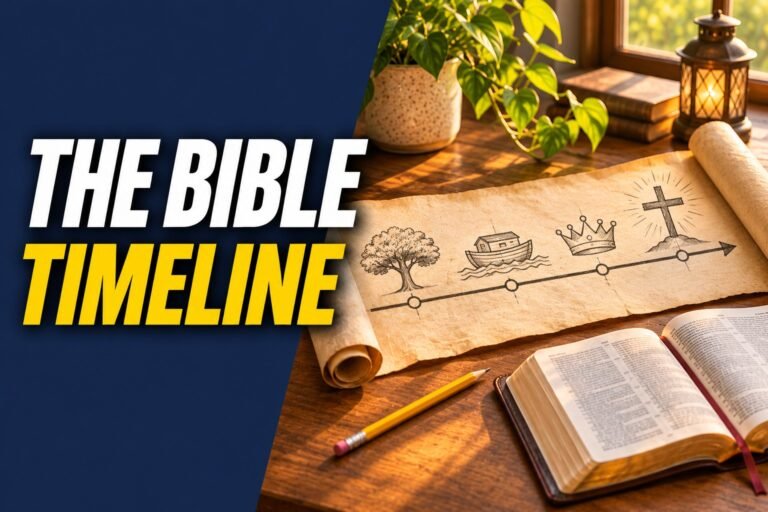
Where does this passage sit on the Bible timeline? What happened right before it? Does it point forward to Jesus, or back to an earlier promise? The Old and New Testaments are constantly quoting and echoing each other, and noticing that is half the fun.
7. What will I do about it?
One thing. Specific. This week. “Be more loving” is too vague to actually do. “Text my sister and apologize” is something you can check off. James says listening without doing is like looking in a mirror and forgetting your own face (James 1:23 to 24), and he’s right.
A quick example: James 1:19 to 27
| Question | Answer |
|---|---|
| Who and to whom? | James, a leader in Jerusalem, writing to scattered Jewish Christians |
| Kind of writing? | A letter full of short, direct instructions |
| What’s happening? | James tells readers to listen more, talk less, and act on what they hear |
| Repeats? | “Hear,” “do,” “word” |
| About God? | He cares how we treat widows and orphans, not just what we say we believe |
| Bigger story? | Echoes Old Testament concern for the vulnerable; points to Jesus’ own teaching |
| What will I do? | Hold my tongue in the meeting I’m dreading tomorrow |
Want the full picture of that book? Read our summary of the book of James.
Tools that help (but aren’t required)
A study Bible gives you background notes on every page. A notebook gives you somewhere to put your answers (see our guide to Bible study notes). And a cross-reference column, the tiny verse numbers in the margin of many Bibles, shows you where the same idea shows up elsewhere.
That’s it. No original Greek required.
FAQ
What’s the best way to study the Bible for beginners?
Pick a short passage, read it twice, and ask the same set of questions every time. Consistency beats complexity.
How is studying the Bible different from reading it?
Reading covers more ground at a normal pace. Studying slows down on a smaller section to understand its context, meaning and application.
How long should a Bible study session be?
Fifteen to thirty minutes is a good start. Even ten focused minutes on a short passage is worthwhile.
Which book of the Bible should I study first?
Mark or James. Both are short, clear and practical, which makes them great for practicing these questions.
Can I study the Bible on my own?
Yes, and it’s worth doing. It also helps to talk through what you’re learning with a friend, small group or church, since other people catch things you’ll miss.